South African doctor building breakthrough apps - Real Innovation is needed for Change

South African doctor building breakthrough apps - Real Innovation is needed for Change
A South African doctor hopes to transform the medical field by developing products and services that solve problems typically experienced by remote and underfunded state hospitals and clinics, reports Rapport.
One of these projects solves two of the most significant issues facing South Africa’s medical industry — the lack of job placements for new graduates and understaffed and underfunded state hospitals and clinics.
Dr Juandre Klopper and two friends, Dr Matt te Water Naudé and mathematician Freddie O’Donnell, developed an app that pairs hospitals seeking locums with young doctors looking for work.
But it was not only this app, there is also innovation around cheaper and more effective medical devices, as well as managing nursing care, all taking into account South Africa's unique challenges.
With dwindling financial resources, increasing demand on medical care, things will only get worse and worse over time if real innovation (technology as well as procedural) is not applied. I've seen the same thing happening with public benefit charities getting smaller grants from government (where are the ever-increasing taxes going? I have no idea...) and having to innovate themselves to survive. Some charities have even raised grant funding from foreign countries.
South Africans have always been very resilient in the face of overwhelming challenges. In one way these will benefit everyone globally, but from another perspective this is extremely sad too that such adversity needs to be overcome. Yes, I know you're thinking now: Imagine if governments themselves could be this innovative! Imagine more better services at every lower tax rates... Governments the world around today seem to be the least efficient businesses of all.
See https://mybroadband.co.za/news/software/565029-doctors-apps-decrease-burdensome-cost-of-medtech.html
#technology #health #SouthAfrica #southafrica
A South African doctor hopes to transform the medical field by developing products and services that solve problems typically experienced by remote and underfunded state hospitals and clinics, reports Rapport.
One of these projects solves two of the most significant issues facing South Africa’s medical industry — the lack of job placements for new graduates and understaffed and underfunded state hospitals and clinics.
Dr Juandre Klopper and two friends, Dr Matt te Water Naudé and mathematician Freddie O’Donnell, developed an app that pairs hospitals seeking locums with young doctors looking for work.
But it was not only this app, there is also innovation around cheaper and more effective medical devices, as well as managing nursing care, all taking into account South Africa's unique challenges.
With dwindling financial resources, increasing demand on medical care, things will only get worse and worse over time if real innovation (technology as well as procedural) is not applied. I've seen the same thing happening with public benefit charities getting smaller grants from government (where are the ever-increasing taxes going? I have no idea...) and having to innovate themselves to survive. Some charities have even raised grant funding from foreign countries.
South Africans have always been very resilient in the face of overwhelming challenges. In one way these will benefit everyone globally, but from another perspective this is extremely sad too that such adversity needs to be overcome. Yes, I know you're thinking now: Imagine if governments themselves could be this innovative! Imagine more better services at every lower tax rates... Governments the world around today seem to be the least efficient businesses of all.
See https://mybroadband.co.za/news/software/565029-doctors-apps-decrease-burdensome-cost-of-medtech.html
#technology #health #SouthAfrica #southafrica
South Africa’s Home Affairs needs a visible Dashboard for Uptime Monitoring of Service and Network Uptimes
South Africa’s Home Affairs needs a visible Dashboard for Uptime Monitoring of Service and Network Uptimes
There’s an old adage that says ‘What you cannot measure, you cannot manage’ which is actually not fully true, because many things have to be managed that do not have any hard metrics to go by. But the principle of having some signals and metrics does indeed greatly assist with determining whether a service is improving or declining. For the Department of Home Affairs, this would include a metric to indicate the mainframe service is fully operational, and then a metric for each and every remote DHA office’s connectivity status. From a technology perspective, if those lights were all green, it should be 100% operational. If the mainframe system is not green, then everything is unavailable countrywide. If some site offices show red lights, it means they have no connectivity at those DHA offices.
This should not be very complicated, as there are many free and open source tools that do this type of job very well. For such example is Uptime Kuma which I use to monitor and alert me of issues with my own hosted services (pictured below). Home Assistant and Grafana can also be used to provide additional analytics and alerting if necessary to e-mail addresses, mobile phones, Telegram Groups, etc. There are probably other uptime monitors that can do an even better job.
I've expanded the comments further in my post linked below, along with a few images.
See South Africa’s Home Affairs needs a visible Dashboard for Uptime Monitoring of Service and Network Uptimes
#technology #southafrica #quality #opensource
There’s an old adage that says ‘What you cannot measure, you cannot manage’ which is actually not fully true, because many things have to be managed that do not have any hard metrics to go by. But the principle of having some signals and metrics does indeed greatly assist with determining whether a service is improving or declining. For the Department of Home Affairs, this would include a metric to indicate the mainframe service is fully operational, and then a metric for each and every remote DHA office’s connectivity status. From a technology perspective, if those lights were all green, it should be 100% operational. If the mainframe system is not green, then everything is unavailable countrywide. If some site offices show red lights, it means they have no connectivity at those DHA offices.
This should not be very complicated, as there are many free and open source tools that do this type of job very well. For such example is Uptime Kuma which I use to monitor and alert me of issues with my own hosted services (pictured below). Home Assistant and Grafana can also be used to provide additional analytics and alerting if necessary to e-mail addresses, mobile phones, Telegram Groups, etc. There are probably other uptime monitors that can do an even better job.
I've expanded the comments further in my post linked below, along with a few images.
See South Africa’s Home Affairs needs a visible Dashboard for Uptime Monitoring of Service and Network Uptimes
There's an old adage that says 'What you cannot measure, you cannot manage' which is actually not fully true, because many things have to be managed that do not have any hard metrics to go by. But the principle of having some signals and metrics does indeed greatly assist with determining whether a service is...
#technology #southafrica #quality #opensource
South African Military Vehicles in War Thunder
War Thunder is a highly realistic battle game where players can choose from a number of armoured vehicles, tanks, ships, helicopters and planes represented for different countries. The player chooses a country and vehicle type, and works their way up from tier 1, progressing to higher tier vehicles as they gain battle experience. The vehicles are incredibly detailed and have characteristics that are closely resemble their real-world counterparts. An exception is often the premium vehicles that can be bought as they can have some enhanced features e.g. slightly faster turret rotation speed than the real-world vehicle. But each online battle tries to match players and similar vehicle tiers to ensure good game play.
I mentioned briefly in the video about World of Tanks which is another very popular tank battle game. Whilst World of Tanks focuses more on a faster-paced arcade type game with numerous points needed before knocking out an enemy vehicle, War Thunder can eliminate an enemy tank with just a single shot if it is very well placed. War Thunder has larger maps, more vehicle types, and plays at a slightly slower pace.
What to me is very interesting is it is the only online game I'm aware of that has a variety of South African military vehicles in it including the Eland, Ratel, Rooikat, Olifant tank, and even the Rooivalk attack helicoptor. The Ratel, for example, is considered to be the very first true wheeled ICV (Infantry Combat Vehicle) top enter military service anywhere in the world, and for its time was one of the best ICVs anywhere. It is regarded by most military analysts as the grandfather of all subsequent ICV designs. The Ratel became the backbone of the then SADF (now SANDF) mechanised battalions and served with distinction during 12 of the 26 years of the South African Border War.
Note though what War Thunder shows as the G6/Eland, is actually the G6 Rhino Self-Propelled Howitzer-Vehicle with 155mm artillery gun. The real Eland is a 4-wheel drive armoured car with a 60mm or 90mm quick-firing gun.
See
#technology #gaming #southafrica #warthunder
I mentioned briefly in the video about World of Tanks which is another very popular tank battle game. Whilst World of Tanks focuses more on a faster-paced arcade type game with numerous points needed before knocking out an enemy vehicle, War Thunder can eliminate an enemy tank with just a single shot if it is very well placed. War Thunder has larger maps, more vehicle types, and plays at a slightly slower pace.
What to me is very interesting is it is the only online game I'm aware of that has a variety of South African military vehicles in it including the Eland, Ratel, Rooikat, Olifant tank, and even the Rooivalk attack helicoptor. The Ratel, for example, is considered to be the very first true wheeled ICV (Infantry Combat Vehicle) top enter military service anywhere in the world, and for its time was one of the best ICVs anywhere. It is regarded by most military analysts as the grandfather of all subsequent ICV designs. The Ratel became the backbone of the then SADF (now SANDF) mechanised battalions and served with distinction during 12 of the 26 years of the South African Border War.
Note though what War Thunder shows as the G6/Eland, is actually the G6 Rhino Self-Propelled Howitzer-Vehicle with 155mm artillery gun. The real Eland is a 4-wheel drive armoured car with a 60mm or 90mm quick-firing gun.
See
#technology #gaming #southafrica #warthunder
Cape Town Disaster Management Centre has a 24/4 VarAC Chat Service running
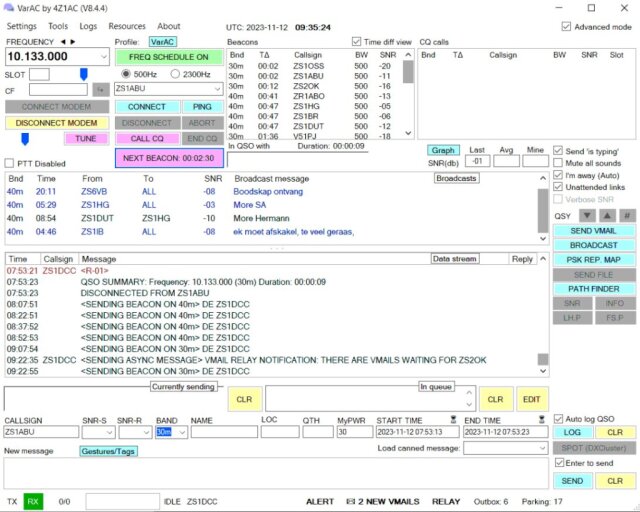
Our ZS1DCC Disaster Management site for #amateurradio #hamradio in #CapeTown now has a 24/7 #VarAC chat service running on HF usually on 30m or 40m, and can be used to park or relay VMails anytime for operators in #SouthAfrica
Yoh Vote is an app that helps South African youth discover their ideal political partner in a fun and 'dating-like' way
In the last national election, over 30 percent of voters didn't participate, indicating a concerning lack of engagement. Many young people, disheartened by the belief that their vote won't matter, have opted out of the system. Yoh, Vote is here to change that mindset and rekindle the fire of political participation.
They understand that the overwhelming flood of information and jargon can be off-putting (as well as all the political double-speak). That's why they're creating a fresh and non-partisan platform. Yoh Vote aims to simplify the process of engaging with political parties and understanding their standpoints, making it easier for young South Africans to make informed decisions about the future of their nation.
Introducing Yoh Vote, a dynamic initiative born from the passion of young South Africans who firmly believe in the potential of their country. They aim to empower every citizen with the right and responsibility to be politically informed and engaged in our hard-fought democracy.
It's not to be confused with the US app called Yo Vote! I heard about this app from an interview with the co-founder by Newzroom Afrika at https://youtu.be/zYPZcqGz9fI?si=G_Hl8vv1phAKtdkn. You'd think politicians, or the IEC, would have come up with a solution like this already, but it goes to show how far-removed politics is from the youth. This initiative is a student-led team of 6 individuals that are seeking to encourage voter registration and youth involvement in South African politics.
The app is web based, so the matchmaking can be done with any desktop computer or mobile browser by just visiting the page linked below. I took the test myself, and it actually aligned with what I had last voted, but you may be surprised to get a different outcome from what you thought your alignment may be.
See Yoh, Vote | South Africa
#technology #SouthAfrica #democracy #voting
They understand that the overwhelming flood of information and jargon can be off-putting (as well as all the political double-speak). That's why they're creating a fresh and non-partisan platform. Yoh Vote aims to simplify the process of engaging with political parties and understanding their standpoints, making it easier for young South Africans to make informed decisions about the future of their nation.
Introducing Yoh Vote, a dynamic initiative born from the passion of young South Africans who firmly believe in the potential of their country. They aim to empower every citizen with the right and responsibility to be politically informed and engaged in our hard-fought democracy.
It's not to be confused with the US app called Yo Vote! I heard about this app from an interview with the co-founder by Newzroom Afrika at https://youtu.be/zYPZcqGz9fI?si=G_Hl8vv1phAKtdkn. You'd think politicians, or the IEC, would have come up with a solution like this already, but it goes to show how far-removed politics is from the youth. This initiative is a student-led team of 6 individuals that are seeking to encourage voter registration and youth involvement in South African politics.
The app is web based, so the matchmaking can be done with any desktop computer or mobile browser by just visiting the page linked below. I took the test myself, and it actually aligned with what I had last voted, but you may be surprised to get a different outcome from what you thought your alignment may be.
See Yoh, Vote | South Africa
Yoh, Vote is an initiative that sets out to encourage youth voter registration ahead of the 2024 National Elections.
#technology #SouthAfrica #democracy #voting
Inside SA Rugby’s technology data-driven approach to the Boks winning the sport’s biggest tournament
From Maree’s description, Saru’s technological ecosystem can be delineated into two distinct processes: data collection and data-driven decision making.
The main tool used for data collection is a GPS tracker, called a GPS pod, which each player has inserted into a sleeve in the back of their rugby jersey. The sleeve is designed so that the pod sits tightly inside it to minimise movement. “The one thing you don’t want with GPS is unwanted movement because it is going to affect the readings,” Maree said. The pod is cleverly positioned between the shoulder blades to minimise the chances of collision during rucks, mauls and scrums.
The Springboks use tracking pods made by STATSports, an Irish company that supplies analysis software along with the tracking hardware. “We developed the system a few years ago with our partner, Mobii System – a local company. Our latency, at 0.25s from live, makes us the quickest system in the world at this stage,” Maree said. The very same data is used for post-game video analysis using Hudl Sportscode. “From the GPS pod together with STATSports, there are probably over 200 or even 300 metrics that you can look at".
This is really no surprise, as most average athletes carry smartwatches and other sports tracking devices already for measuring their own performance (and we've long seen racing cars carrying such analytical information). It is not so much the measurement device, but more the power of the available analytics that separates amateur from professional levels. AI also is said to not yet play any role, but I would imagine they are playing with that to see how it compares with human deduction and decision-making, after all AI is all about learning from data, and AI may help give an additional edge in terms of the speed of decision-making in future.
The other thing I'm really wondering about is security. The moment something starts using technology with any form of connectivity, it is potentially at risk to hacking. Whether that is just intelligence gathering by the opposition, gathering of information by the opposition, or a denial-of-service attack, all these risks can potentially be harmful, especially when you come to depend more and more on the technology. So I guess Chief Risk Officer, CIO< etc all take on new meanings for even sports teams.
With today's digital era, and streaming of entertainment media, it would be interesting to see some of the basic data being broadcast during games like max speed reached by a player, distance travelled, etc that could make it more interesting.
See The Boks' secret tech weapon going into Rugby World Cup - TechCentral

#technology #rugby #SouthAfrica
The main tool used for data collection is a GPS tracker, called a GPS pod, which each player has inserted into a sleeve in the back of their rugby jersey. The sleeve is designed so that the pod sits tightly inside it to minimise movement. “The one thing you don’t want with GPS is unwanted movement because it is going to affect the readings,” Maree said. The pod is cleverly positioned between the shoulder blades to minimise the chances of collision during rucks, mauls and scrums.
The Springboks use tracking pods made by STATSports, an Irish company that supplies analysis software along with the tracking hardware. “We developed the system a few years ago with our partner, Mobii System – a local company. Our latency, at 0.25s from live, makes us the quickest system in the world at this stage,” Maree said. The very same data is used for post-game video analysis using Hudl Sportscode. “From the GPS pod together with STATSports, there are probably over 200 or even 300 metrics that you can look at".
This is really no surprise, as most average athletes carry smartwatches and other sports tracking devices already for measuring their own performance (and we've long seen racing cars carrying such analytical information). It is not so much the measurement device, but more the power of the available analytics that separates amateur from professional levels. AI also is said to not yet play any role, but I would imagine they are playing with that to see how it compares with human deduction and decision-making, after all AI is all about learning from data, and AI may help give an additional edge in terms of the speed of decision-making in future.
The other thing I'm really wondering about is security. The moment something starts using technology with any form of connectivity, it is potentially at risk to hacking. Whether that is just intelligence gathering by the opposition, gathering of information by the opposition, or a denial-of-service attack, all these risks can potentially be harmful, especially when you come to depend more and more on the technology. So I guess Chief Risk Officer, CIO< etc all take on new meanings for even sports teams.
With today's digital era, and streaming of entertainment media, it would be interesting to see some of the basic data being broadcast during games like max speed reached by a player, distance travelled, etc that could make it more interesting.
See The Boks' secret tech weapon going into Rugby World Cup - TechCentral
Exclusive | Inside SA Rugby’s data-driven approach to the Boks winning the sport’s biggest tournament.
#technology #rugby #SouthAfrica
How to (try to) stop spam callers in South Africa
South Africans can take several measures to minimize the amount of spam calls and unsolicited marketing they are regularly bombarded with.
In 2021, Truecaller’s Global Spam & Scam Report found that South Africa had the 9th-highest rate of spam calls in the world. That was a massive jump from 17th place in 2020.
The popular call-screening app found that South Africans received an average of 13.2 monthly spam calls per user.
So even though there is legislation, and I've opted out, I still get a few calls every day. It is true, there may be some older form that still has a tick (or no tick) next to "Yes I'd love marketing calls" or "Don't give my number to 3rdparty suppliers", but either ways, the calls just don't stop.
Truecaller has really worked well for me, so well, that I had to get rid of my iPhone and move back to an Android phone, as the Truecaller app is crippled on iOS due to not having dialler permissions.
So, this app is really the only way as reporting to the police, and opting out, just don't seem to work in practice. It is a nightmare in South Africa as far as managing it goes, and opting out of marketing calls.
See How to stop spam callers
#technology #southafrica #spamcalls #Truecaller
In 2021, Truecaller’s Global Spam & Scam Report found that South Africa had the 9th-highest rate of spam calls in the world. That was a massive jump from 17th place in 2020.
The popular call-screening app found that South Africans received an average of 13.2 monthly spam calls per user.
So even though there is legislation, and I've opted out, I still get a few calls every day. It is true, there may be some older form that still has a tick (or no tick) next to "Yes I'd love marketing calls" or "Don't give my number to 3rdparty suppliers", but either ways, the calls just don't stop.
Truecaller has really worked well for me, so well, that I had to get rid of my iPhone and move back to an Android phone, as the Truecaller app is crippled on iOS due to not having dialler permissions.
So, this app is really the only way as reporting to the police, and opting out, just don't seem to work in practice. It is a nightmare in South Africa as far as managing it goes, and opting out of marketing calls.
See How to stop spam callers
#technology #southafrica #spamcalls #Truecaller
South Africans can take several measures to minimise the amount of spam calls and unsolicited marketing they are regularly bombarded with.
South African government has launched its own official app store and is inviting local developers to register
DigiTech is a digital products portal of South Africa that is supported by the Department of Communications and Digital Technologies. The purpose of DigiTech is to collect data about digital products developed in South Africa with an aim of supporting the products’ technology enablement and promote and expand their adoption and use. Through DigiTech, the Department of Communications and Digital Technologies seeks to promote SA developed digital products in other markets whilst facilitating partnerships with other countries on co-promotion of local technologies.
The Marketplace shows some really interesting government / citizen related apps. So it is not clear if this site will merely promote suitable apps, that are then downloaded from the actual Apple, Android, and other apps stores. The Marketplace page contains no links at all to any of the actual apps being promoted. SA Government already actually has a single central portal for citizens, called eServices. I would have thought that would also have been the place for citizens, not only to transact with gov, but to also obtain this information about mobile apps to use.
So yes, an early review by Business Insider, was not glowing about this site at all. It is possibly because it is not well explained how it fits into the existing ecosystem of services and apps by government for citizens. It also has a few grammar errors, and no secure SSL certificate. The eServices site also started out with lots of fanfare a few years ago, but no-one speaks about it really in the media any more. This new site does not even link to the eServices site.
Besides that, though, the initiative is a good one to promote local developers and apps that will assist citizens.
See Marketplace | DigiTech
#technology #southafrica #government #mobileapps #DigiTech
The Marketplace shows some really interesting government / citizen related apps. So it is not clear if this site will merely promote suitable apps, that are then downloaded from the actual Apple, Android, and other apps stores. The Marketplace page contains no links at all to any of the actual apps being promoted. SA Government already actually has a single central portal for citizens, called eServices. I would have thought that would also have been the place for citizens, not only to transact with gov, but to also obtain this information about mobile apps to use.
So yes, an early review by Business Insider, was not glowing about this site at all. It is possibly because it is not well explained how it fits into the existing ecosystem of services and apps by government for citizens. It also has a few grammar errors, and no secure SSL certificate. The eServices site also started out with lots of fanfare a few years ago, but no-one speaks about it really in the media any more. This new site does not even link to the eServices site.
Besides that, though, the initiative is a good one to promote local developers and apps that will assist citizens.
See Marketplace | DigiTech
#technology #southafrica #government #mobileapps #DigiTech
This website uses cookies to help us give you the best experience when you visit our website. By continuing to use this website, you consent to our use of these cookies. This website uses cookies to help us give you the best experience when you visit our website. By continuing to use this website, you consent to our use of these...
iSinkwe app, developed by CSIR in South Africa, can help children with their reading and listening skills in all 11 official SA languages
The app, called iSinkwe – the isiZulu word for a bushbaby – adds and synchronises human-narrated or computer-generated audio to text. It aims to make textbooks, class notes and other documents more accessible to learners by making reading and learning more interactive.
iSinkwe functions by adding audio, which can be recorded manually by someone or generated by a computer using a standard Electronic Publication Version Three (EPUB3) document, to text documents.
There is already an Android app, with an iOS app and a Windows store app still to follow.
See CSIR develops app to help kids learn to read
#technology #SouthAfrica #reading #literacy #education

iSinkwe functions by adding audio, which can be recorded manually by someone or generated by a computer using a standard Electronic Publication Version Three (EPUB3) document, to text documents.
There is already an Android app, with an iOS app and a Windows store app still to follow.
See CSIR develops app to help kids learn to read
#technology #SouthAfrica #reading #literacy #education
The CSIR has developed an app to help children with their reading and listening skills.
Disney+ vs Netflix — South African libraries and features compared
A Disney+ subscription in South Africa will offer less than half the titles available on Netflix but boasts superior features at a lower price.
Disney+ is launching locally on 18 May 2022, with a monthly price of R119 or an annual subscription of R1,190.
Walt Disney Africa recently provided a complete list of all of the content that will be available on the service. These include popular movies and TV shows from Disney’s Marvel, Star Wars, Pixar, and National Geographic properties. It will also boast a wide range of adult-focused movies and TV shows from its Star catalogue, including content created by FX, 20th Century Studios, and 20th Century TV.
The linked article helps highlight many of those differences for South Africans. What we don't see though is what epic movies may be available on Disney that South Africa's are currently not getting on Netflix, as that could be a decider for many.
See Disney+ vs Netflix — South African libraries and features compared
#technology #southafrica #streaming #netflix #disney
Disney+ is launching locally on 18 May 2022, with a monthly price of R119 or an annual subscription of R1,190.
Walt Disney Africa recently provided a complete list of all of the content that will be available on the service. These include popular movies and TV shows from Disney’s Marvel, Star Wars, Pixar, and National Geographic properties. It will also boast a wide range of adult-focused movies and TV shows from its Star catalogue, including content created by FX, 20th Century Studios, and 20th Century TV.
The linked article helps highlight many of those differences for South Africans. What we don't see though is what epic movies may be available on Disney that South Africa's are currently not getting on Netflix, as that could be a decider for many.
See Disney+ vs Netflix — South African libraries and features compared
#technology #southafrica #streaming #netflix #disney
Disney+ is coming to South Africa on 18 May. This is how its library and features stack up to video streaming leader Netflix.